lingua


For example, under the recent outbreak of the new crown virus, thermal imaging cameras have occupied a very important position. It may not directly detect the presence of pathogens. But let’s be honest, no device is better at detecting fever, the main symptom of a viral infection, from a safe distance than an infrared camera. No wonder it is now a permanent fixture at the entrance to malls and other public places.
Therefore, a careful understanding of how thermal imaging cameras work is crucial. By gaining more knowledge, you will be able to get the most out of your thermal imaging camera as it has revolutionized our lives on Earth. And for the most part, when you want to keep things running smoothly, you can be more productive and efficient.
Scelerisque imaginis intra: quomodo operatur
Knowing what infrared radiation is one thing, capturing it is another. We must understand that thermal imaging as we know it today is the product of a long and tortuous process that took decades to perfect. On the one hand, our thermal imaging cameras today are powerful and user-friendly. Not only are they heavy and expensive, unlike those used by firefighters decades ago.
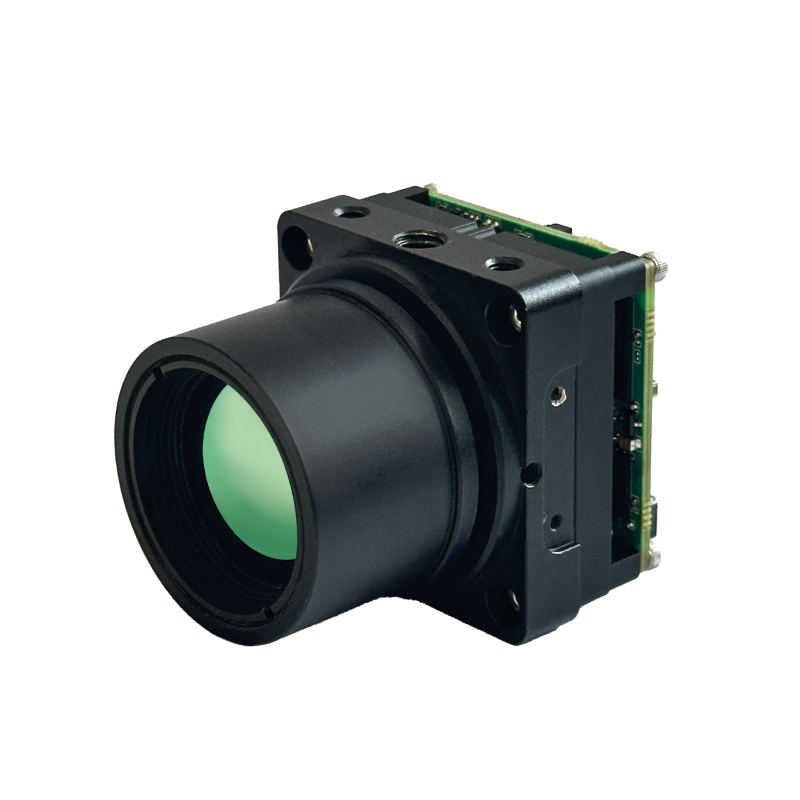
Since thermal imaging cameras are designed to capture thermal energy in the surrounding environment, their main components are designed to process infrared radiation. This is especially true of input units. We're talking about lenses and sensors, the path that infrared radiation has to travel through.
Lens
Think of the lens of a thermal camera, like your eyelid. If your eyelids aren't open, you won't be able to see your surroundings. For its part, a thermal imager must have a lens that allows IR and its various frequencies to pass through. Only then can the sensor process the signal.
This is the biggest difference between an infrared camera and a standard camera (the camera on your phone). Unlike regular cameras, the lenses of infrared cameras must not be made of glass. Note that glass blocks long-wave infrared radiation (LWIR), the frequency most useful for thermal imaging.
Solent ergo lentium fieri ex germanio, zinci selenide, calcium fluoride, vel sapphiro. Hoc faciens, lens accommodare potest radialem spectrum electromagnetici scelerisque 7 ad 14µm extensionem. Cum pleraque harum materiarum summam refractivam habeant indicem, criticum est adhibere anti-cogitationem efficiens ad lensum ad corrigendum pro deflexione.
Sensor
The heart of a thermal imaging camera is the sensor. This is where the infrared radiation passes through the heat detector. This detector responds directly to the increase in heat that occurs due to the absorption of incident infrared light.
Autem, tempore, duae sunt eminentissimae modi ad officium faciendum. Recentior et communis ars hodie per microbolometris adhibita est, cum alia accessio ad materias pyroelectricas utatur. Singula sunt haec.
Microbolometer
In principio, microbolometer radiatio est fabrica sensitiva. Primus bolometer ab Americano physicus/astronomo inventor Samuel Pierpont Langley (1834-1906) repertus est.
Any radiation that directly strikes the absorbing element of the microbolometer will result in a corresponding increase in temperature. The more energy absorbed, the higher the temperature.
This temperature change can be directly measured using a resistance thermometer. and read out as an electronic signal to produce an electronic image. Essentially, a microbolometer consists of a thin layer of metal, which is then connected directly to a (thermostatic) thermal reservoir via a thermal link.
The sensor array is home to thousands of detector pixels arranged in a grid. Knowing that each pixel in the array reacts to infrared radiation that hits it directly, creating a resistance that can then be converted into an electrical signal. The signal from each pixel is processed by applying a mathematical formula that forms the basis for a colormap of the captured object temperature. The subsequent color picture is then sent to the camera's processing unit for display.
Know that each pixel has a microbolometer for greater accuracy. Therefore, the resolution of thermal cameras is quite low compared to smart TVs or normal cameras. In fact, 640x480 has already been considered a high resolution for thermal cameras.
Microbolometer-based thermal imaging cameras are also known as uncooled thermal imaging cameras because a separate cooling mechanism is not required to operate the microbolometer sensor. The immediate advantage is that these IR cameras are lighter compared to traditional cooled models.
Pyroelectric materia
These are thermal cameras that use cooled sensor detectors. A shining example is lithium tantalate. The material generates tiny voltages in direct response to changes in temperature. In this sense, it directly detects infrared photons. It is photovoltaic rather than uncooled microbolometer-based thermal cameras that use photoconductivity.
Although they offer many advantages, such as long-range infrared detection and more accurate temperature differential results, cooled thermal cameras are gradually being replaced by uncooled devices. This is mainly due to their more expensive price tags and bulky bodies.
These infrared detectors are heavy by today's standards because their imaging sensors must be integrated with cryocoolers. To make matters worse, the moving parts in cryocoolers are prone to wear and tear over time.
Imago processus
After acquiring the infrared radiation, the data must be processed to create the output seen on the infrared camera screen. Data processing includes preprocessing, feature extraction, and classification. Note that filtering is used to remove noise or unwanted data. Here, algorithms or mathematical equations are used to generate visual images.
Exhibit
This is where the data from the camera's processor is converted into electronic signals. Remember that said data is taken from each pixel (non-cooled). By applying mathematical algorithms, a colormap can be generated. This represents a distinct thermal signature of the object under study. Previously, achromatic or black-and-white representations were common in thermal imaging displays.
De ThermTec
ThermTec est globalis opifex productorum de technologiarum imaginum thermarum ultrarubrum, technologias ac solutiones melioris ac melioris thermarum technologiarum, quae meliorem viam hominum percipiunt, ita tutiorem et efficaciorem vivendi et operandi conditionem hominibus construunt.