言語
言語


For example, under the recent outbreak of the new crown virus, thermal imaging cameras have occupied a very important position. It may not directly detect the presence of pathogens. But let’s be honest, no device is better at detecting fever, the main symptom of a viral infection, from a safe distance than an infrared camera. No wonder it is now a permanent fixture at the entrance to malls and other public places.
Therefore, a careful understanding of how thermal imaging cameras work is crucial. By gaining more knowledge, you will be able to get the most out of your thermal imaging camera as it has revolutionized our lives on Earth. And for the most part, when you want to keep things running smoothly, you can be more productive and efficient.
サーマルイメージャーの内部: その仕組み
Knowing what infrared radiation is one thing, capturing it is another. We must understand that thermal imaging as we know it today is the product of a long and tortuous process that took decades to perfect. On the one hand, our thermal imaging cameras today are powerful and user-friendly. Not only are they heavy and expensive, unlike those used by firefighters decades ago.
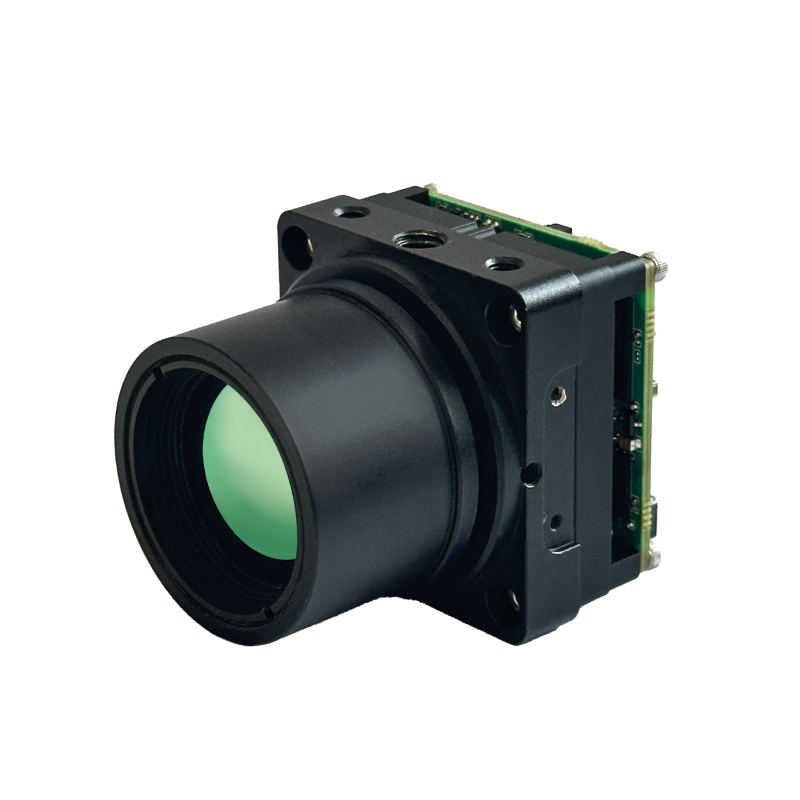
Since thermal imaging cameras are designed to capture thermal energy in the surrounding environment, their main components are designed to process infrared radiation. This is especially true of input units. We're talking about lenses and sensors, the path that infrared radiation has to travel through.
レンズ
Think of the lens of a thermal camera, like your eyelid. If your eyelids aren't open, you won't be able to see your surroundings. For its part, a thermal imager must have a lens that allows IR and its various frequencies to pass through. Only then can the sensor process the signal.
This is the biggest difference between an infrared camera and a standard camera (the camera on your phone). Unlike regular cameras, the lenses of infrared cameras must not be made of glass. Note that glass blocks long-wave infrared radiation (LWIR), the frequency most useful for thermal imaging.
したがって、レンズは通常、ゲルマニウム、セレン化亜鉛、フッ化カルシウム、またはサファイアで作られています。そうすることで、レンズは7~14μmの熱放射電磁スペクトル範囲に対応できます。これらの材料のほとんどは屈折率が高いため、たわみを補正するためにレンズに反射コーティングを施すことが重要です。
センサー
The heart of a thermal imaging camera is the sensor. This is where the infrared radiation passes through the heat detector. This detector responds directly to the increase in heat that occurs due to the absorption of incident infrared light.
ただし、時間が経つにつれて、仕事を完了するための最も有力な方法が 2 つあるようになります。現在使用されている新しい一般的な技術はマイクロボロメータを使用するものであり、別のアプローチは焦電材料を使用することです。詳細は以下の通り。
マイクロボロメーター
原理的に、マイクロボロメータは放射線感受性のデバイスである。最初のボロメーターは、アメリカの物理学者/天文学者発明家サミュエル ピアポント ラングレー (1834-1906) によって発明されました。
Any radiation that directly strikes the absorbing element of the microbolometer will result in a corresponding increase in temperature. The more energy absorbed, the higher the temperature.
This temperature change can be directly measured using a resistance thermometer. and read out as an electronic signal to produce an electronic image. Essentially, a microbolometer consists of a thin layer of metal, which is then connected directly to a (thermostatic) thermal reservoir via a thermal link.
The sensor array is home to thousands of detector pixels arranged in a grid. Knowing that each pixel in the array reacts to infrared radiation that hits it directly, creating a resistance that can then be converted into an electrical signal. The signal from each pixel is processed by applying a mathematical formula that forms the basis for a colormap of the captured object temperature. The subsequent color picture is then sent to the camera's processing unit for display.
Know that each pixel has a microbolometer for greater accuracy. Therefore, the resolution of thermal cameras is quite low compared to smart TVs or normal cameras. In fact, 640x480 has already been considered a high resolution for thermal cameras.
Microbolometer-based thermal imaging cameras are also known as uncooled thermal imaging cameras because a separate cooling mechanism is not required to operate the microbolometer sensor. The immediate advantage is that these IR cameras are lighter compared to traditional cooled models.
焦電材料
These are thermal cameras that use cooled sensor detectors. A shining example is lithium tantalate. The material generates tiny voltages in direct response to changes in temperature. In this sense, it directly detects infrared photons. It is photovoltaic rather than uncooled microbolometer-based thermal cameras that use photoconductivity.
Although they offer many advantages, such as long-range infrared detection and more accurate temperature differential results, cooled thermal cameras are gradually being replaced by uncooled devices. This is mainly due to their more expensive price tags and bulky bodies.
These infrared detectors are heavy by today's standards because their imaging sensors must be integrated with cryocoolers. To make matters worse, the moving parts in cryocoolers are prone to wear and tear over time.
画像処理プロセッサ
After acquiring the infrared radiation, the data must be processed to create the output seen on the infrared camera screen. Data processing includes preprocessing, feature extraction, and classification. Note that filtering is used to remove noise or unwanted data. Here, algorithms or mathematical equations are used to generate visual images.
展示品
This is where the data from the camera's processor is converted into electronic signals. Remember that said data is taken from each pixel (non-cooled). By applying mathematical algorithms, a colormap can be generated. This represents a distinct thermal signature of the object under study. Previously, achromatic or black-and-white representations were common in thermal imaging displays.
サームテックについて
ThermTec は、赤外線サーマル イメージング技術に関する製品の世界的大手メーカーであり、人々の世界の認識方法を改善し、人類にとってより安全で効率的な生活と労働条件を構築する最新かつ最高の熱技術とソリューションを提供しています。